
Effective Systems: The Engine Behind Flow
Most businesses don’t fail because of bad ideas — they fail because their systems can’t keep up with their ambition.
Gary Lockley
10/31/20252 min read
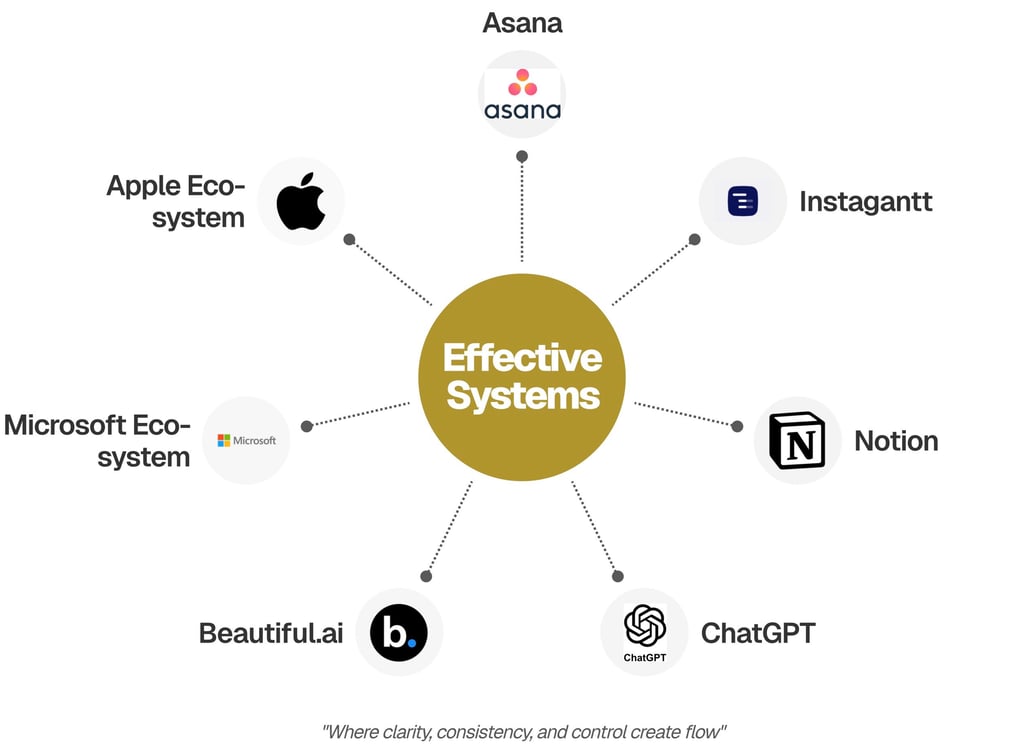
Effective Systems: The Engine Behind Flow
Most businesses don’t fail because of bad ideas, they fail because their systems can’t keep up with their ambition.
We live in a world of endless tools and apps, each claiming to save time or simplify work. But true effectiveness doesn’t come from having more software; it comes from creating systems that work together.
This is where operational excellence meets digital discipline.
1. The Problem with Fragmented Systems
Over the past decade, the number of SaaS tools used by the average SME has tripled.
According to Productiv’s 2024 SaaS Trends Report, the average mid-sized company now uses 130+ separate applications, yet only 45% of users feel their tools actually improve collaboration.
That fragmentation kills flow.
Every time a task gets copied between systems or an idea lives in isolation, you lose both time and context. In an operations or eCommerce environment, this translates directly into slower decision cycles, missed dependencies, and frustrated teams.
At CoreFlow, I see this daily when diagnosing operational bottlenecks, the issue isn’t lack of technology; it’s the lack of an effective operating system.
2. Building a System That Works in Unison
To practice what we preach, CoreFlow’s own workflow is designed around integration and clarity.
Here’s how our “Effective Systems” model operates:
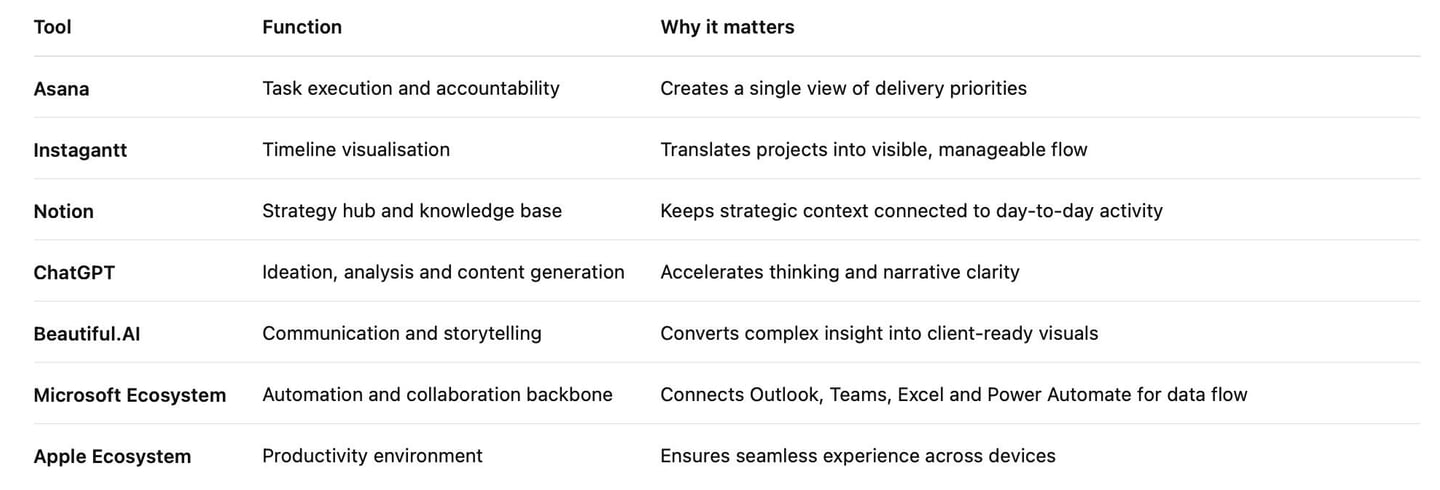

Each of these tools has a role — but the system is what creates the outcome.
Everything is connected: a client project in Asana syncs with the strategy board in Notion; reporting templates are generated through ChatGPT; outputs are visualised in Beautiful.AI.
The aim isn’t complexity — it’s coherence.
3. The CoreFlow Principle: Clarity, Consistency, Control
At the heart of CoreFlow’s advisory work lies a simple principle:
“When systems flow, businesses scale.”
I define effective systems through three qualities:
Clarity: Every process, tool and dashboard serves a defined purpose — no noise.
Consistency: Repetition breeds reliability; reliability breeds trust.
Control: Leaders can see the whole system at a glance — and make decisions faster.
This philosophy underpins how I design operating models for clients, whether optimising supply chains, eCommerce operations, or business transformation programmes.
4. The ROI of Flow
The impact of effective systems is tangible.
A McKinsey Digital 2023 study found that organisations with strong system integration and workflow automation see up to 45% faster decision-making and 30% higher employee satisfaction.
In our own client work, system alignment has reduced reporting time by up to 70% and improved delivery predictability across cross-functional teams.
When your tools talk to each other, your team stops spending time translating work — and starts spending time doing work.
5. Building Your Own System of Flow
If you’re reading this and wondering where to start, here’s a practical first step:
Map your current systems (tools, workflows, data handoffs).
Identify duplication or manual friction points.
Redesign around a single source of truth — one system of record that anchors everything else.
Use automation (Microsoft Power Automate, Zapier, or native integrations) to connect the dots.
The result? Fewer handovers, faster visibility, and teams that feel in sync — because the system takes care of the structure.
Final Thought
Technology should create flow, not friction.
When your systems are connected and intentional, your business operates with the same rhythm as your ambition.
At CoreFlow, this is how I work, and how I help our clients build organisations that run with clarity, consistency and control.
Connect
Get in touch for operational excellence.
CONTACT DETAILS
info@coreflowadvisory.com
+44 7872 519697
© 2025 CoreFlow Advisory Ltd | All rights reserved.